Tuesday, December 4, 2007
Event 3
For my third event, I attended the "Heartbreak House" performance on Thursday November 29th. I enjoyed supporting my friends in their performance by attending, but I really didn't enjoy the play as a whole. The acting was phenomenal, and the props were beautiful. The play itself, however, was way too confusing. The dialogue was clever and quick, much like the show "Gilmore Girls." However, it was too random and confusing for much of the audience to understand. I didn't really get anything after the first act. When I asked those around me, they didn't understand either. I also asked many of the tech crew members, and they didn't know either. I thought this play was a poor choice, given the audience hadn't already read the play, analyzed it, and understood it. Overall, I am glad that I attended this event because I was able to support my friends, and actually have the experience of attending a school play.

Saturday, December 1, 2007
Wikipedia vs. Britannica or Public vs Private
Is Wikipedia reliable? Is it worth going to? Would you prefer to go to a place like “Britannica Online” or Wikipedia to search for a topic? For our final blog assignment, the First Year Seminars were asked to pick a topic, and compare a Wikipedia article an Encyclopedia Britannica article. It was quite difficult to find two pages that were relevant to one another, since Wikipedia covers many more topics than Britannica. I chose skin cancer as my topic because while there is not a lot of controversy over skin cancer, there is room for misinformation. I compared these two articles on the basis of attribution, recency, references, links, consistency, bias/controversy, and my overall impressions of the quality of each page.
Attribution, or who is responsible for the information provided in a piece of writing, is very important in determining the quality of the information being received, and a useful tool when a reader would like to contact the author. While Britannica Online does not note the author on the page or any contact information, this web site does have a place to comment on an article. A reader can ask questions, comment on something, or point out any mistakes (spelling or otherwise) that need to be addressed. The Wikipedia article is a whole other story. The listed editors (located under the “history” tab) consisted of bots, Wikipedia editors and administrators, a few good citizens, and many anonymous users, with no user details. One Wikipedia worker was kind enough to list all of his editing history, the reason for his nickname, and what research he does on the side. Under his username, there is a tab labeled “discussion” in which many people have left comments and questions, as a way of contacting him. This is great for those who have questions, but its still leaves the worry about those users that have no user page and no way of being contacted.
Recency is vital to a topic, especially one that is time sensitive, like cancer. The Britannica article was last edited in the year 2007. I would personally like more information--was it edited early this year, or just recently? The date is very important, especially if new information has been found since then. In Wikipedia’s article, under the tab “history” the last edit is listed as November 29, 2007, with the hour and minute of the edit. This is helpful, because I know that if there were recent breakthroughs on skin cancer, and no new information had been added in a long time, that article wouldn’t be as relevant. Both these sites made it easy to find out when they were last updated, but Britannica Online wasn’t as specific as I would have liked it to be.
References are helpful when determining the reliability of a source. This specific Wikipedia article lists three references at the very bottom of the page. Two links are from the internet (thus, clickable) and one is a book, with its listed ISBN number. One link takes me to a British Pathology website (which looks homemade), and another link leads me to the National Cancer Institute (which is quite reliable and professional). Britannica Online does not give a bibliography, but it does have links to further readings, located in the grey “expand your research” rectangle on each page of the article. They seem very reliable, and have very good information for anyone who wishes to research further. They are all clickable and lead me to websites like CNN and Medicinenet, which are well known and accredited sites for information. Both of these sites have reasonable references, but in this area, I am more likely to count on Britannica for respectable references.
Updated links are very important to a webpage’s credibility. Sites that have “dead” or broken links are most likely not updated on a regular basis, and thus not necessarily up-to-date on all the information. Apart from the references, Britannica’s article consisted of 12 links that were all up-to-date and working. The Wikipedia article had approximately 38 links, one of which was being edited for content. Overall, both of these sites prove to be keeping up-to-date with their links.
Both the Wikipedia and Britannica articles had similar information. Wikipedia seemed to have more specifics, and overall more information in the article itself than that of Britannica. Wikipedia also listed skin cancer as having three categories, and Britannica considered skin cancer to have only two categories. Both of these are consistent with other websites (neither are wrong). Wikipedia seemed to have more specific facts, and Britannica seemed much more general in the information they provided.
When clicking “discussion” and “history” on Wikipedia, I can find evidence of much controversy over skin color and its relation to skin cancer. There is much discussion over recent vandalism on that page, and it seems the whole page was wiped clean not too long ago. Some people seem to get offended over certain mentioning of color and gender in relation to the likelihood of skin cancer. There is no comparable section on Britannica Online.
Finally, both articles are quality. Both articles are thorough, professionally worded, and overall seem to speak the truth. I however, preferred Wikipedia because it can tell me what topics are controversial, where people found their information, and allow me to come up with my own opinion. However, I would not use Wikipedia as a valid source for any paper because its information is easily compromised. I would be more likely to cite Britannica Online, or one of its references in a paper because that is a more professional and viewed reliable world-wide.
Attribution, or who is responsible for the information provided in a piece of writing, is very important in determining the quality of the information being received, and a useful tool when a reader would like to contact the author. While Britannica Online does not note the author on the page or any contact information, this web site does have a place to comment on an article. A reader can ask questions, comment on something, or point out any mistakes (spelling or otherwise) that need to be addressed. The Wikipedia article is a whole other story. The listed editors (located under the “history” tab) consisted of bots, Wikipedia editors and administrators, a few good citizens, and many anonymous users, with no user details. One Wikipedia worker was kind enough to list all of his editing history, the reason for his nickname, and what research he does on the side. Under his username, there is a tab labeled “discussion” in which many people have left comments and questions, as a way of contacting him. This is great for those who have questions, but its still leaves the worry about those users that have no user page and no way of being contacted.
Recency is vital to a topic, especially one that is time sensitive, like cancer. The Britannica article was last edited in the year 2007. I would personally like more information--was it edited early this year, or just recently? The date is very important, especially if new information has been found since then. In Wikipedia’s article, under the tab “history” the last edit is listed as November 29, 2007, with the hour and minute of the edit. This is helpful, because I know that if there were recent breakthroughs on skin cancer, and no new information had been added in a long time, that article wouldn’t be as relevant. Both these sites made it easy to find out when they were last updated, but Britannica Online wasn’t as specific as I would have liked it to be.
References are helpful when determining the reliability of a source. This specific Wikipedia article lists three references at the very bottom of the page. Two links are from the internet (thus, clickable) and one is a book, with its listed ISBN number. One link takes me to a British Pathology website (which looks homemade), and another link leads me to the National Cancer Institute (which is quite reliable and professional). Britannica Online does not give a bibliography, but it does have links to further readings, located in the grey “expand your research” rectangle on each page of the article. They seem very reliable, and have very good information for anyone who wishes to research further. They are all clickable and lead me to websites like CNN and Medicinenet, which are well known and accredited sites for information. Both of these sites have reasonable references, but in this area, I am more likely to count on Britannica for respectable references.
Updated links are very important to a webpage’s credibility. Sites that have “dead” or broken links are most likely not updated on a regular basis, and thus not necessarily up-to-date on all the information. Apart from the references, Britannica’s article consisted of 12 links that were all up-to-date and working. The Wikipedia article had approximately 38 links, one of which was being edited for content. Overall, both of these sites prove to be keeping up-to-date with their links.
Both the Wikipedia and Britannica articles had similar information. Wikipedia seemed to have more specifics, and overall more information in the article itself than that of Britannica. Wikipedia also listed skin cancer as having three categories, and Britannica considered skin cancer to have only two categories. Both of these are consistent with other websites (neither are wrong). Wikipedia seemed to have more specific facts, and Britannica seemed much more general in the information they provided.
When clicking “discussion” and “history” on Wikipedia, I can find evidence of much controversy over skin color and its relation to skin cancer. There is much discussion over recent vandalism on that page, and it seems the whole page was wiped clean not too long ago. Some people seem to get offended over certain mentioning of color and gender in relation to the likelihood of skin cancer. There is no comparable section on Britannica Online.
Finally, both articles are quality. Both articles are thorough, professionally worded, and overall seem to speak the truth. I however, preferred Wikipedia because it can tell me what topics are controversial, where people found their information, and allow me to come up with my own opinion. However, I would not use Wikipedia as a valid source for any paper because its information is easily compromised. I would be more likely to cite Britannica Online, or one of its references in a paper because that is a more professional and viewed reliable world-wide.
Thursday, November 8, 2007
Mark Hertzgaard's Visit
Mark Hertzgaard visited the FYS classes in a lecture in Irion Hall. Beforehand a couple of students from each of the class, and some of the professors had lunch and a discussion with him. We focused a lot on our FYS class Local Choices, Global Effects. He seemed very impressed with our class and what we were doing with waste management, sustainable living, and energy. He also talked about the presidential candidates, and where to find information on what they stand for in the climate change/going green areas of their campaigns. He was very intent upon not telling us which party or candidate he supported. I completely respect this, because as a journalist, his responsibility is to give unbiased information about the candidates and what they stand for---not to persuade the public to follow his opinion.
Event 2
On Tuesday, October 30 I went to the showing of Smoke Signals in the Illinois room at 4:00 pm. This movie was about two Native American teenagers living on a Reserve in the United States. These two boys, who were not friends, go on a journey to Arizona to recover the dead body of one of the boys’ father. These two boys leave the Reserve into basically a different country where stereotypes about Native Americans rule what people think of them. They run into some very interesting characters including a substitute for the Olympics, two very prejudiced white police officers, a drunken abusive man and his wife and their friends, and a friend of the boy’s father. Many of these individuals hold their own views of what Native Americans are like, and treat the boys thusly. Slowly, as the boys make their journey, the stereotypes that many Americans have about Native Americans disappear. This movie ends with the boy recovering the ashes of his father, and coming to the terms with the fact that although his father left him and his mother, he did genuinely love them. The two boys split the man’s ashes and one dumps the ashes into the river, and the other gives the ashes to the mother. The boys form a very strong bond that cannot be broken, even if they don’t remain good friends.
After the movie, we talked as a group about the movie and the stereotypes that many Americans have about Native Americans. We all agreed that this movie had a great balance between viewing Native Americans as savages, and Romanticizing them, like some movies do (like Dances With Wolves). This movie educated all of us about the Native American culture and the stereotypes about them. I would recommend this movie to anyone who was interested in this topic.
After the movie, we talked as a group about the movie and the stereotypes that many Americans have about Native Americans. We all agreed that this movie had a great balance between viewing Native Americans as savages, and Romanticizing them, like some movies do (like Dances With Wolves). This movie educated all of us about the Native American culture and the stereotypes about them. I would recommend this movie to anyone who was interested in this topic.
Sustainable Living Project Presentation Reflection
For this project, I was responsible for coming up with ideas for new courses on sustainable living, while my partner researched what our school already offered on this subject. I felt like the two of us did a really thorough job on our topic, and our audience seemed very interested in the ideas that we came up with. I think that if I had more time, I would have extended what other schools offered in courses, and what we would take from that.
Overall, I think we did a pretty good job on our presentation. I felt like this time, our actual presentations skills were improved, but our information was lacking a bit in comparison to our first project. I know that we didn’t follow through on our due dates because of extenuating circumstances, but I believe that there should have been a back-up plan because it wasn’t really fair to Jason (our power-point creator). I preferred our audience during this presentation to our previous audience. They seemed much more genuinely interested in what we had to say, and seemed genuinely interested in changing things about our school in order to make it better. They asked a lot of good questions about our presentation, our opinions, and the class in general.
Also, many of my classmates seemed much more confident, well dressed, and prepared for the project. It was actually very cool to see the normally quiet students speak up, present and defend their ideas, and answer good questions. I also saw a lot of students encouraging one another before they presented, which was also a cool bonding experience.
Overall, I think we did a pretty good job on our presentation. I felt like this time, our actual presentations skills were improved, but our information was lacking a bit in comparison to our first project. I know that we didn’t follow through on our due dates because of extenuating circumstances, but I believe that there should have been a back-up plan because it wasn’t really fair to Jason (our power-point creator). I preferred our audience during this presentation to our previous audience. They seemed much more genuinely interested in what we had to say, and seemed genuinely interested in changing things about our school in order to make it better. They asked a lot of good questions about our presentation, our opinions, and the class in general.
Also, many of my classmates seemed much more confident, well dressed, and prepared for the project. It was actually very cool to see the normally quiet students speak up, present and defend their ideas, and answer good questions. I also saw a lot of students encouraging one another before they presented, which was also a cool bonding experience.
Wednesday, November 7, 2007
Event: Dr Goldsmith's Lecture
On Wednesday, October 24th, I attended a small dinner at the Chaplain's house followed by a psychology lecture by Dr. Goldsmith on Erikson's works. Since I had no idea who Erikson was, and have no interest in studying psychology, I was quite confused for the most part. However, there were some points that I thought were very useful. He told a story about how one of his patients was a two year old girl, who was developmentally behind. Apparently, the child would not go to sleep in her own bed--even if she started out in her own bed, she would sneak into her parents' room in the middle of the night. It had become somewhat of a routine. The mother was distressed about this and asked Dr. Goldsmith what to do. He gave her great advice, saying that she should make the child's room into a fun theme, and have playtime in the girl's room, so the little girl would associate her room and her bed as a positive and happy place. Since it was around Halloween the previous year, the mother decorated the young girl's room in a pumpkin patch, and played with her daughter like she was told. When the girl and the mother came back for the next visit, Dr. Goldsmith was told that the little girl slept in her bed alone, every night. I particularly liked this story because I babysit for a developmentally behind four year old with the same problem. I relayed Dr. Goldsmith's advice to this woman, and I hope that it works for them.
Overall, Dr. Goldsmith's lecture focused on different ages and what they need developmentally. He also focused on three aspects of life: work, love and leisure. He really stressed our need to have an appropriate balance of these in order to be content with our lives. I thought this was a great point--since a lot of us can either get too caught up in our work, or too lazy and leisurely to do any work. I somewhat enjoyed this lecture--but I think that the psychology students appreciated it a lot more--since they actually knew the majority of what he was talking about.
Overall, Dr. Goldsmith's lecture focused on different ages and what they need developmentally. He also focused on three aspects of life: work, love and leisure. He really stressed our need to have an appropriate balance of these in order to be content with our lives. I thought this was a great point--since a lot of us can either get too caught up in our work, or too lazy and leisurely to do any work. I somewhat enjoyed this lecture--but I think that the psychology students appreciated it a lot more--since they actually knew the majority of what he was talking about.
Thursday, October 25, 2007
Toxins in my shampoo? What is the world coming to?
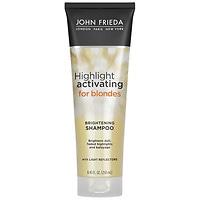
For our First Year Seminar Class, Christine Smith sent us to two sites to look for products we use every day, and to see if they contain harmful toxins and if they meet certain standards, are tested to lead to cancer, etc. The site http://www.ewg.org/ was much more helpful and easier to understand than http://www.thegreenguide.com/, so most of my research is based on ewg.org.
The first product I looked up was my shampoo--Pantene Pro-V's John Frieda Collection--Sheer Blonde Highlight Activating Shampoo. I learned that my shampoo is connected with cancer, allergies, skin irritation, and organ system toxicity, among many others. They also have violated many restrictions, and are not a signer with Compact for Safe Cosmetics. The Toxin level is at 5, which is considered moderate. However, now that I know that this product is associated with many health concerns, I will not be using this product. I have enough health conce rns (many of which could be connected to this product) and I would rather not add to them. I would also like to use a product that takes a strong sense against animal testing, and since this product isn't labelled either way, I'd rather not risk it. Honestly, what is the world coming to if I can't even wash my hair without going through the danger of exposing myself to cancer-causing chemicals. Seriously, don't these products have to be labelled or something?
 rns (many of which could be connected to this product) and I would rather not add to them. I would also like to use a product that takes a strong sense against animal testing, and since this product isn't labelled either way, I'd rather not risk it. Honestly, what is the world coming to if I can't even wash my hair without going through the danger of exposing myself to cancer-causing chemicals. Seriously, don't these products have to be labelled or something?
The second product I researched was the Dove Beauty Bar--Sensitive Skin. This product had a toxin level of 3, which is very low. There is no connection between this product and cancer, and this product doesn't violate any restrictions, which is always good. However, this product is still connected to allergies and skin irriations, but nothing too serious. The only real downside to this product is that it tests on animals. However, I don't believe that I will be changing my soap anytime soon because of the differences of cost between this product and soaps of a lower concern. Most of the other products that I could use that would be better for me are twice as expensive and are not sold at the average convenience store.
Through this research I learned a lot more about being a responsible consumer. I have already had better skin reactions since I stopped using my Sheer Blonde shampoo. I am very grateful for this assignment, its leading to a healthier lifestyle already.
Subscribe to:
Comments (Atom)